


Discover & Learn

2026-03-02T17:19:04
Home | Pablo Vasquez
Last call for 2025 RRSPs Can you hear the ticking? That’s the clock for 2025 Registered Retirement Savings Plan (RRSP) contributions. Today, Monday, March 2, is the final day to make contributions for the 2025 year. This is prime time for clients looking to maximize contributions and optimize tax benefits. Can’t make the deadline? No problem. I encourage you to contribute for 2026 instead. Unused contribution room carries forward indefinitely, allowing you to catch up on retirement savings, claim tax deductions and benefit from tax-deferred growth. Remember, every contribution matters. Let me help you to take action now to strengthen your financial security and manage your tax burden effectively. Request an appointment here: https://advisor.rbcfinancialplanning.com/pablo-vasquez/

2026-02-27T14:30:10
Cost of living, low tuition fees, and one of the highest post-secondary full-time employment rates makes Calgary the sixth most desirable city for youth to work in Canada. See how Calgary stacks up against 27 cities in 11 different categories in this year’s Youthful Cities Urban Work Index presented by RBC Future Launch. https://bit.ly/2RKSSfk

2026-02-12T16:53:18
The 'Great Narrowing': S&P 500 concentration
The “Great Narrowing” of the S&P 500 reflects a structural shift, where a handful of technology and AI-driven giants now dominate the index’s composition, performance and risk profile. While current leaders boast robust fundamentals, strong profitability, competitive advantages and growth trajectories, the sheer concentration of market value in a narrow cohort introduces new risk. The disconnect between weight and earnings contribution, outsized influence of individual stocks and passive inflows amplifying this dynamic underscore a critical reality—what appears as broad diversification increasingly functions as a concentrated allocation in a single thematic outcome. For investors, this evolution requires a recalibration of assumptions. The index has been a resilient benchmark, but its top-heavy structure warrants scrutiny. Understanding embedded risks, from idiosyncratic volatility to thematic correlation, is more essential than ever, in our view. Read details Here: https://www.rbcwealthmanagement.com/en-ca/insights/the-great-narrowing-sp-500-concentration

2026-02-02T16:37:18
More signs of stability expected in Canadian and U.S. job markets
More signs of stability expected in Canadian and U.S. job markets Looking ahead, Canadian firms hiring intentions remained subdued, according to the latest Bank of Canada Business Outlook Survey—and most business survey data is suggesting wage growth will edge lower. Job postings from Indeed, however, paint a more optimistic picture with hiring demand rising since September 2025 to levels close to the pre-tariff peak in January 2025. Sectors heavily exposed to international trade disruptions, like manufacturing, continue to underperform, but we continue to expect a stabilizing trade backdrop and strength in domestic demand will support a rebound in hiring overall. We look for the unemployment rate to edge gradually lower to 6.3% by the end of this year. Read more here: https://www.rbc.com/en/economics/forward-guidance/forward-guidance-our-weekly-preview/

2026-01-30T13:49:26
Podcast: The 10-Minute Take
Breaking the trade trap: Can Canada diversify fast enough? Canada’s extreme trade concentration—with 75% of energy exports and 77% of manufacturing exports going to the U.S. in 2024—has left the country vulnerable to protectionist trade policies. While 2025 data shows encouraging early signs of diversification, most Canadian exporters still lack the infrastructure and trade channels needed to pivot away from U.S. markets effectively. In this episode of the 10-Minute Take, RBC Economics’ Claire Fan and Carrie Freestone are joined by colleague Salim Zanzana for a conversation on: Canada’s concentrated trade reality and how it’s evolved in the past year. What early diversification efforts reveal about Canadian exporters adapting. Recent developments between Canada and China and their economic impact. Listen to our newest episode here or wherever you get your podcasts: https://www.rbc.com/en/economics/the-10-minute-take/
2026-01-27T16:27:46
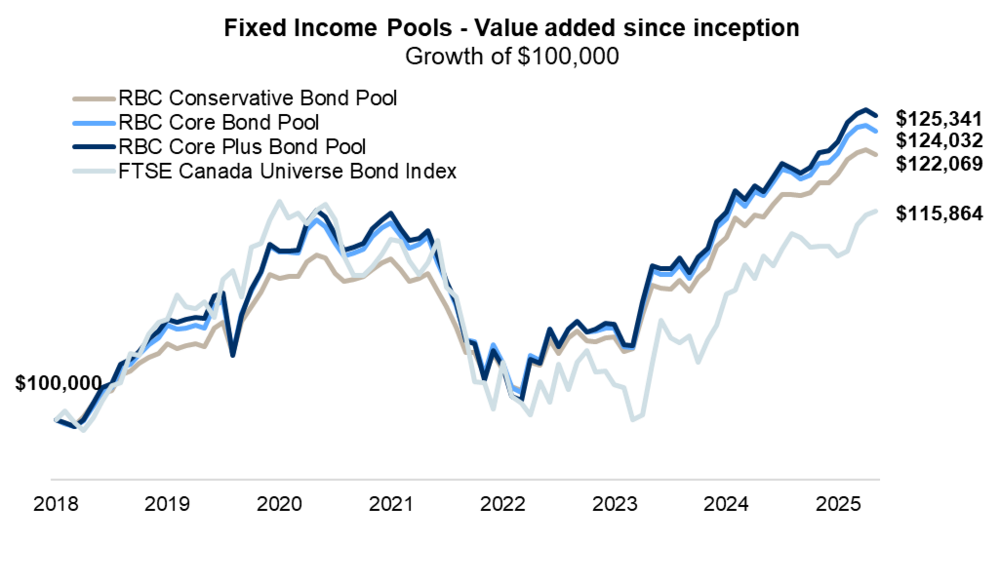
Why active management matters for fixed income Let's be honest - fixed income can get complicated fast. Between navigating diverse bond sectors, analyzing yield curve dynamics and monitoring credit quality across multiple jurisdictions - the complexity can overwhelm even seasoned investment professionals. Most advisors simply don't have the time to manage all these moving parts themselves. This is exactly why actively managed fixed income funds like RBC's Fixed Income Pools make sense. Advisors can rely on dedicated fixed income specialists to provide their clients with all the benefits of an actively managed portfolio without the time and brain power required to do it themselves. It's a one-ticket solution that delivers built-in diversification, rebalancing and tactical adjustments - making fixed income easier, smarter and far less time-consuming to manage. Capitalizing on market opportunities helps deliver enhanced returns Active managers add value by making decisions that a static benchmark simply can't. They adjust duration in response to interest rate changes, actively manage credit exposure and diversify across sectors and geographies. They also use tactical allocation to adjust the asset mix as new opportunities in markets arise to generate incremental value in the portfolios and mitigate risks as market events unfold. The first chart shows the growth of $100,000 invested in the actively managed RBC Fixed Income Pools since their inception on August 20, 2018, versus the FTSE Canada Universe Bond Index. The Conservative, Core and Core Plus pools outperformed the index by 72 to 109 basis points annually net of fees, depending on the fund. This outperformance represents the value added from making tactical allocation decisions based on the current market environment. Diversifying helps reduce volatility One of the biggest advantages of actively managed fixed income funds is the diversification they can offer. For example, RBC Fixed Income Pools can invest across a wide range of fixed income markets, including: • Canadian investment-grade bonds • Global government and corporate bonds • High-yield debt • Emerging market debt • Active currency exposure This broader opportunity set helps spread out the risks and create more consistent sources of return. As the chart below shows that over the past five years, RBC Fixed Income Pools have delivered not only higher returns but also lower risk than both the median peer group and the FTSE Canada Universe Bond Index. It's a clear example of how active diversification and tactical asset allocation can improve your clients' risk-return profile. See chart 2 Access to lower-cost managed solutions RBC Fixed Income Pools are structured to provide a very cost-effective way to access diversified bond portfolios. The table attached shows the current series F management expense ratios (MER) for RBC Fixed Income Pools versus what it would cost to buy all the underlying funds individually. There are significant cost savings with the Pools - saving 0.10% to 0.21% in management fees compared to the do-it-yourself approach. Final thoughts At the end of the day, actively managed fixed income is about making a complex part of the portfolio easier to handle. For advisors, it means you can outsource the day-to-day monitoring and tactical decisions within your clients’ bond portfolios, freeing up your time to focus on what matters most - your clients and their goals. With professional oversight, enhanced diversification and cost savings, these solutions can help improve outcomes and provide more consistency than a passive approach. by Julia Sirbovan, RBC Associate Portfolio Analyst, RBC Global Asset Management Inc.

Pablo Vasquez, PFP
Financial Planner, Investment and Retirement Planning
Let's work together to achieve your financial goals